
Ask one capable AI assistant to research a problem, make a decision, write the code, operate the server and judge its own result, and you have placed every responsibility in one pair of hands.
That can be perfectly sensible for a small task. It becomes fragile when the work is long-running, risky or crosses several disciplines. The assistant has to keep changing jobs: analyst, developer, designer, security reviewer, tester and operator. Details get lost between those roles, and the same system that made a change is then asked to provide the independent proof that the change is safe.
Specialist agents offer a different structure. They are not merely the same chatbot speaking in different tones. In a properly designed setup, each can have its own instructions, tools, access limits, standards and queue of work. The value is focus and ownership—not theatre about pretending software is a group of people.
Start with the structure
The basic model
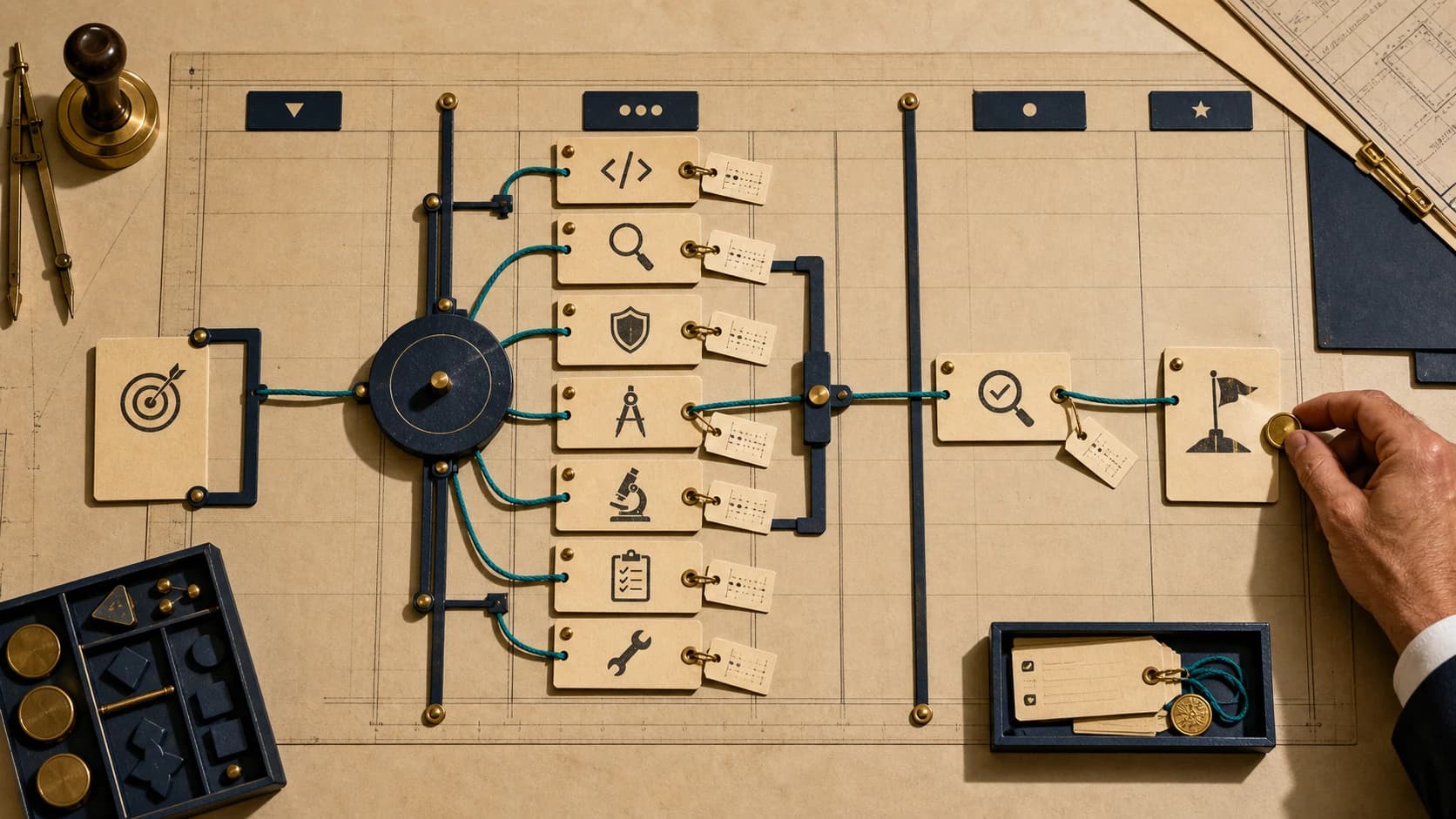
The human starts with an outcome, not an organisation chart. It might be: “Make the stock page reliable and ship the fix safely.” A lead agent—often called the boss, manager or orchestrator—works out what that sentence really requires.
It inspects the current situation, identifies the unknowns and chooses the smallest sensible workflow. Some work may happen in sequence; independent research may happen in parallel. The important point is that each piece has a clear owner and a definition of done.
A person describes the outcome and important boundaries.
The orchestrator inspects, splits and sequences the work.
Bounded workers complete tasks with the right context and tools.
Evidence is checked before the lead reports or acts.
You should be able to state a normal business outcome. The agent system should absorb the coordination overhead.
A small digital team
Who does what?
The exact team depends on the work. These are useful recurring lanes, not compulsory characters that must appear in every task.
Lead / orchestrator
Owns
The complete outcome: understanding the goal, inspecting existing work, creating useful tasks, sequencing dependencies and checking the final result.
Coder and bug investigator
Owns
Implementation and tests. A separate investigator can concentrate on an unclear failure before anyone starts changing code based on a guess.
Quality assurance
Owns
Reproducing the original problem and proving whether the finished change meets the agreed scenarios. QA should be free to disprove the fix.
Operations
Owns
Containers, services, logs, networking, deployment, monitoring and live health. A correct code change is not yet a healthy running service.
Security reviewer
Owns
Authentication, credentials, exposed endpoints, dependency concerns and whether each worker has more authority than its task requires.
Research
Owns
Vendor documentation, APIs, product behaviour and architecture options. It returns evidence and uncertainty rather than quietly making production decisions.
Designer and communicator
Owns
User experience, visual direction and customer-facing language. It judges the work from the audience's perspective rather than treating presentation as a final coat of paint.
A concrete handover
A broken stock page, handled as a team
Imagine an internal operations dashboard whose marketplace stock page has stopped updating. The visible symptom is one broken page, but the cause could sit in application code, an external API, a credential, a background worker, networking or stale deployment configuration.
A proportionate workflow might look like this:
- the orchestrator confirms the real failure, recent changes and what “reliable” means;
- research checks the external API's current behaviour while the bug investigator traces logs and the failing data path;
- the coder fixes the confirmed cause and adds tests that would have caught it;
- security reviews how tokens and error details are handled;
- QA reproduces the original failure and tests ordinary, delayed, empty and error responses; and
- operations deploys the approved change and verifies the live service, logs and data freshness.
Dependencies matter. QA cannot verify code that does not exist, and deployment should not race ahead of a security decision. Research and log inspection, however, may be useful in parallel. The lead agent holds that map.
Coordination is real work
What the orchestrator is responsible for
A lead agent is not simply the most powerful worker. Its responsibility is to keep the work aimed at the outcome.
- Clarify the real result“The page is broken” is a symptom. The outcome might include accurate data, useful failure behaviour, tests, a safe release and evidence that the live page recovered.
- Inspect before delegatingExisting work, project rules and current service state must travel with the task, or specialists will duplicate effort and contradict one another.
- Write bounded briefsEach task needs the relevant context, permitted actions, acceptance criteria, dependencies and a clear place to return evidence.
- Reconnect the piecesSeven individually reasonable answers do not automatically make one coherent outcome. The lead resolves conflicts and verifies the assembled result.
- Escalate real decisionsThe human remains the decision-maker for risk, scope, credentials, publication and other consequential choices.
Focus plus accountability
Why this can work better than one giant agent
A large prompt does not automatically overwhelm a capable model. The problem is repeated context-switching and self-review. The same agent must remember every requirement, investigate unknowns, decide architecture, implement, test, consider security, diagnose deployment and judge whether its own result is good.
Specialisation creates useful tension:
- the coder owns implementation, not the verdict;
- QA owns proof and may reject the coder's result;
- operations owns what actually runs, not what should run;
- security owns the challenge to unnecessary access; and
- the orchestrator owns the complete verified outcome.
This is especially valuable when work crosses application code, services, credentials and external APIs. A code-only view of that problem is incomplete before anyone begins.
Two levels of delegation
Quick work and durable work
Not every specialist needs a permanent identity or a task card. A lead can ask a temporary helper to investigate one bounded question in parallel, receive the findings and close the worker. That is useful internal delegation.
Meaningful work needs a more durable home. In an orchestration system such as Hermes, a Kanban task can retain the brief, acceptance criteria, dependencies, comments, handovers, artifacts, test evidence and blockers that need a human decision.
Kanban is the memory of the work. Agents are the workers. Chat is the human-friendly front door.
That distinction matters when a job crosses days or sessions. The conversation may end; the work does not have to lose its history. A new worker can see what was attempted, what passed, what failed and what remains blocked.
Stay proportionate
When an agent team is overkill
Coordination has a cost. Creating seven tasks for a two-minute request produces ceremony, not quality. A lead agent should handle straightforward work directly, including:
- rewriting a short message;
- finding a file or identifying what uses a port;
- writing a small, low-risk script;
- answering a focused question; or
- checking tomorrow's calendar.
Specialists become worthwhile when the job is multi-step, risky, cross-domain, long-running or benefits from genuinely independent verification.
Permanent profile or disposable helper?
Create a permanent specialist only when the work recurs and benefits from its own memory, skills, permissions or quality standard. Coding, operations, research, design review and QA often become recurring lanes. A one-off question usually belongs with a temporary helper—or with the lead itself.
The short version is simple: tell the lead what you want accomplished. It decides whether the request is direct work or needs a small specialist workflow. The specialists receive bounded jobs; the lead coordinates and verifies; the human keeps the consequential decisions.