
Not every slow task needs AI. Sometimes the best improvement is a clearer form, one source of truth, a better template or a decision that removes the task entirely.
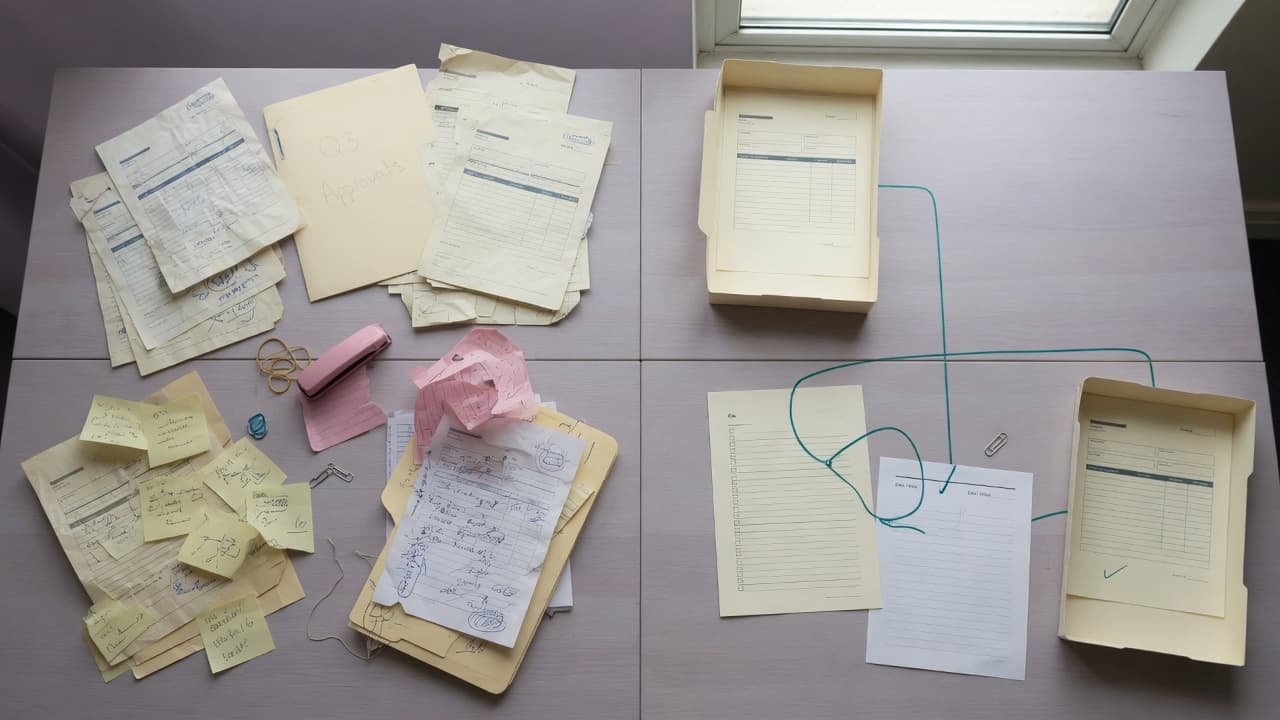
See the current work
Map what actually happens, not the process people wish existed
Follow one item from arrival to completion. Note every place that information is copied, every wait for an answer and every point where someone decides what to do next. The map does not need specialist notation. A page of cards, arrows and real examples is enough to show where work becomes unclear.
Teams often discover that the delay is not the task they first blamed. A customer form may be fine, but the details are retyped into two systems. An inbox may be manageable, but no one owns the handover after a question is answered. Those are process issues before they are AI issues.
Remove avoidable work
Try the boring fixes before adding technology
Can one field be collected earlier? Can a standard answer live in one approved place? Can a shared queue replace messages passed between individuals? Can a simple rule decide the routine cases? These changes reduce variation and give any later automation a more dependable foundation.
This is not an argument against AI. It is a way to give it a defined job. Once the normal route is simpler, AI may be useful for the parts that still require reading a messy document, interpreting a free-text enquiry or drafting a contextual response.
- Remove Stop collecting or copying information that nobody uses.
- Standardise Agree the normal fields, handover and source of truth.
- Clarify Make ownership and decision rules visible to the people doing the work.
- Then automate Only automate steps that remain repetitive, valuable and safe to monitor.
Choose proportionately
Compare a process fix, a rule and AI against the same outcome
For each option, ask what it changes for the person doing the work. A revised form might remove the missing information. A rules-based workflow might send a complete request to the right queue. AI might classify the unusual free-text requests or prepare a response for review. The best answer may use more than one of these.
Do not compare options only by how impressive the demo looks. Compare setup effort, maintenance, confidence in the result, fallback arrangements and whether staff can correct mistakes. A small, reliable improvement is usually more valuable than a clever system that creates a new queue of exceptions.
Prove it
Run a short test against a real operational measure
Pick a small batch and use real variations. Check the ordinary case, incomplete inputs, unusual customer needs and a system outage. Keep the old path available while the new one is being tested, so service does not depend on an unproven change.
After a defined period, compare the result with the original process. Did it reduce handling time, improve completion or make work easier to see? If it did not, adjust the process or stop. A clear decision is more useful than keeping a half-working automation because time has already been spent on it.